
Cost-Based Training.
Built from the research, tested on the gym floor.
One method runs every programme. Every session has a cost, and the method spends it where it pays.
It comes from three places.
1
The research
Studies on training volume and effort, on recovery, and on strength and endurance in the same week. What is established is named as established, and the rest is labelled for what it is.
2
The coaches who wrote the books
Mike Boyle on functional training, Stuart McGill on the lower back, Joe Friel and Matt Fitzgerald on endurance, Alex Viada on hybrid training, and Dan John, Mike Israetel and Eric Helms on strength and muscle.
3
Ten years on the gym floor
Coaching real people every week, and racing on the same programming. A session that reads well but fails in a busy week does not survive.
How every programme is built.
Whichever one you choose.
- Sessions built from movement patterns: squat, hinge, single leg, push, pull and carry. A swap keeps the pattern, so it never breaks the session.
- An effort target on every lifting set, as the reps you have left. Power work is about quality, not effort. The heavy lifts stop two short of failure, and one short only on a test set.
- On Hybrid and Triathlon, nothing goes to failure. In those weeks it is the expensive part.
- The same main lifts held long enough for the load to climb, with recovery weeks built into every block.
- Cardio set by zones, from your own tests once you have taken one, so it scales to you, and most of it genuinely easy.
- Testing weeks through the year, so you see what moved.
One recovery budget.
So lifting and running stop fighting each other.
Running is the expensive part of the week. It is heavily eccentric and it damages muscle, so it costs more recovery than riding. So the weekly budget is shared between lifting and running. When one spends more, the other spends less.
In Hybrid, the running spends first, because it is what you came to get better at, and the lifting takes what is left. That works because a few heavy reps stopped two short of failure cost very little recovery.
In Triathlon, swim, bike, run and strength all draw on the same budget. The lifting holds at two heavy sessions a week, and one in the race block.

Every block climbs, then recovers.
There is no final week.
Volume climbs within every cycle and across the year.
Every block has its recovery weeks built in. They are not time off: they are where the growth you just trained for actually arrives.
The next block starts from the loads you built. It never resets to zero and it never runs out.
Two tracks.
Track 1 is the default on every programme.
| Programme | Track 1 | Track 2 |
|---|---|---|
| Bodybuilding | 4 days | 6 days |
| Hybrid | 5 sessions | 7 sessions |
| Triathlon | 8 sessions | 12 sessions |
In Hybrid and Triathlon, nobody starts on Track 2: complete one block on Track 1 first. Track 2 never adds a hard session, and you can switch at a block boundary.
In Bodybuilding, Track 2 is six days with a restoration day of mobility, breathing and easy cardio. It is the day that keeps the other five honest.

Built from the research.
The way it fits together is ours.
What the research establishes
Muscle
- Training volume drives hypertrophy with diminishing returns.
- Effort matters, and proximity to failure drives growth but flattens close to failure.
- Training muscles at long lengths beats short lengths.
- Failure adds nothing for strength on compound lifts and costs fatigue.
Strength and cardio together
- Interference between strength and endurance work shows up mainly when the two sit in the same session, not when they are separated.
- Whether the endurance work is running or cycling makes no reliable difference to that interference.
- Polarised training, where most running is easy, does no better than other mixes of easy and hard work on time trials or threshold pace. Its one edge, a small one in aerobic capacity, showed only in trials under 12 weeks.
Triathlon
- Most endurance training should be genuinely easy, and the common error is drifting into the middle.
- Critical Swim Speed is a valid way to set swim training paces.
- Bricks prepare athletes for running off the bike.
What is ours
- The way a week fits together: the order of the sessions, the effort targets, and what each one costs.
- Periodising lifting cost against running cost, on one shared recovery budget.
That is our synthesis of the research, tested in our own training and with our clients. It is not a framework a study has proved.
Where the research points
The research on heavy strength work in endurance athletes points to better cycling efficiency and running economy.
What we do not promise
Specific performance gains. Results are individual and never a sure thing.
Sources, by name
- Michael Boyle, Advances in Functional Training (2010)
- Mike Israetel and colleagues, Scientific Principles of Hypertrophy Training (2021)
- Eric Helms, Andy Morgan and Andrea Valdez, The Muscle and Strength Pyramid: Training, 2nd edition (2019)
- Moritz Schumann and colleagues, Compatibility of Concurrent Aerobic and Strength Training for Skeletal Muscle Size and Function, Sports Medicine (2022)
- Cristian Llanos-Lagos and colleagues, The Effect of Strength Training Methods on Middle-Distance and Long-Distance Runners' Athletic Performance, Sports Medicine (2024)
- Pedro Silva Oliveira, Giorjines Boppre and Hélder Fonseca, Comparison of Polarized Versus Other Types of Endurance Training Intensity Distribution on Athletes' Endurance Performance, Sports Medicine (2024)
- Matt Fitzgerald and David Warden, 80/20 Triathlon (2018)
- Joe Friel, The Triathlete's Training Bible, 5th edition (2024)
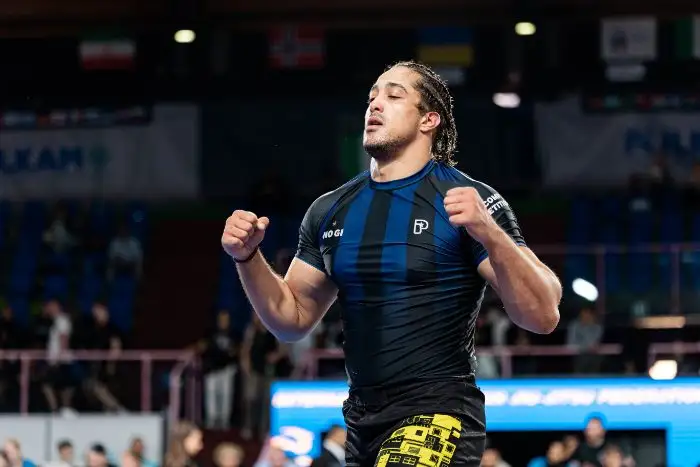
Written by a coach who competes,
not a content team.
Moe is a qualified strength and conditioning coach who races on his own programming. Every block is tested in his own training before it reaches yours, and every session tells you what to do and why. It is the same method behind his 1-to-1 coaching, set up for you to follow at your own pace.
- Sub-70 Hyrox Pro Debut
- ATHX Worlds Qualifier
- 2× Ironman 70.3
Sports science degree. Certified Functional Strength Coach Level 1, with Mike Boyle. British Weightlifting Levels 1 and 2.
1-to-1 coaching with Moe